Jazz bajo las Torres de San Juan de Dios
Original painting of Santa Cruz de Mompox
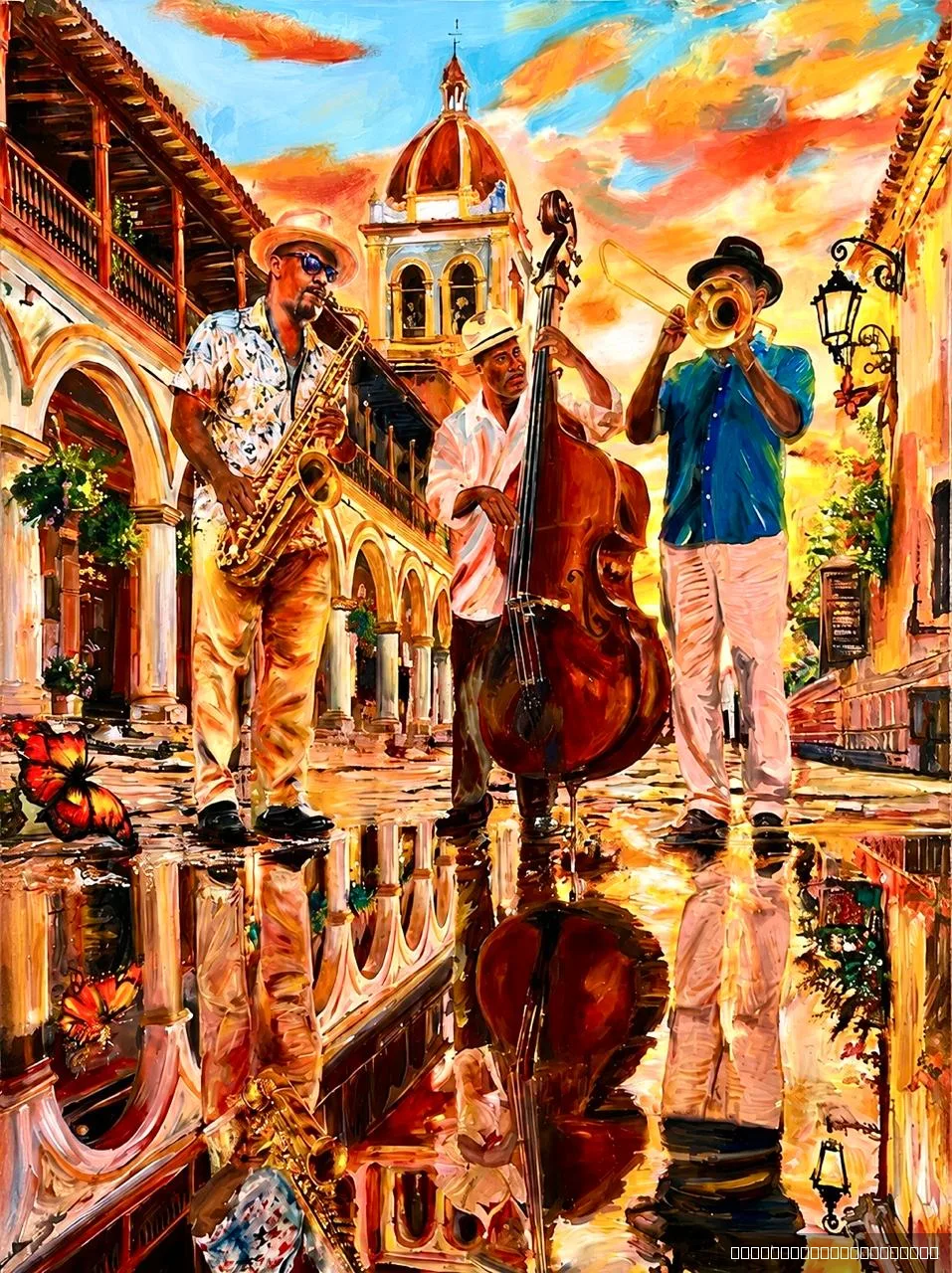
Jazz bajo las Torres de San Juan de Dios, original painting of Santa Cruz de Mompox. Acrylic on canvas, 90 × 140 cm, by Colombian artist Jairo Watts. Available.
At sunset on Calle de San Juan de Dios in Mompox, a saxophone, a double bass and a trombone play during the town's jazz festival, and the wet cobblestones repeat the scene upside down. An original acrylic on canvas from the Mompox collection.
The sun says goodbye to Mompox as if it did not want to leave entirely: it sets the sky ablaze in oranges and reds that tangle with the blue still holding on, and all that fire is reflected, doubled, on the damp cobblestones of Calle de San Juan de Dios. It is the hour when the town, the one that saw independence born, that for centuries kept the oldest hospital in the Americas and that prayed beneath the bell tower now outlined against the burning clouds, transforms, once a year, into something else.
Because when September comes, Mompox stops being only colonial memory. Three musicians have taken over the street as if it were a stage made to measure: the saxophonist, in a straw hat and a flowered shirt, leans over his instrument with his eyes closed behind dark glasses, lost in the note. Beside him, the double bass, taller than its own player, stands like another character in the scene, held by hands that keep the rhythm with the same calm with which the Magdalena River has carried this town for almost five centuries. And on the right, the trombone raises its golden brass voice toward the blazing sky, as if it wanted to converse with the sunset itself.
A butterfly settles, silently, on the wet stones, a tiny witness to this fusion of the sacred and the profane, of the church that gave the street its name and the music that gives it new meaning today. Below, in the reflection on the pavement, the scene repeats itself upside down, as if the town wanted to keep a copy of this moment for its own memory: the very moment when Mompox, the town to which Bolívar said he owed his glory, finds in jazz a new way to resist oblivion and to celebrate that, against all odds, it is still alive.
The work sets its scene on Calle de San Juan de Dios, in the historic center of Mompox, with the tower of its colonial church, built in the sixteenth century and tied for centuries to the hospital work of the Brothers of Saint John of God, presiding over the background of the composition. The artist chooses the moment of sunset, when the sky catches fire in oranges and reds, to transform a street historically associated with spiritual retreat and the care of the body into the stage of a deeply sensory celebration: jazz.
The work pays tribute to the Mompox Jazz Festival, a cultural gathering born in 2012 that every year turns the streets, plazas and colonial balconies of this World Heritage town into a meeting place between music and memory. Three musicians, on saxophone, double bass and trombone, occupy the center of the canvas with an almost sculptural physicality, their bronze and brass instruments catching and returning the golden light of dusk, in direct dialogue with the golden facades of the buildings that frame them.
The device of the reflection, which the artist has been exploring in his Mompox series, takes on a particular dimension here: the wet pavement doubles the scene and inverts it, suggesting that the town, which in 1810 was among the first to declare absolute independence from Spain and to which Bolívar attributed his own glory, does not merely watch this musical present, but keeps it, archives it on its own surface, as it has done with every chapter of its history.
The discreet presence of the butterfly, resting on the damp stone in the foreground, introduces a note of fragility and transformation: a silent counterpoint to the chromatic and sonic intensity that dominates the rest of the composition, a reminder that beneath the glow of the festival the town remains, above all, a living organism that keeps transforming without losing its essence.
More than a documentary record of the event, the work offers a reflection on Mompox's ability to reinvent its own symbols: a street named for faith and care becomes, without losing its historical weight, the stage for a new form of community and collective celebration.
Details
- Technique
- Acrylic on canvas
- Size
- 90 × 140 cm
- Year
- 2026
- Collection
- Mompox
- Place
- Santa Cruz de Mompox
- Status
- Available
- Price
- USD $2,037
An original painting by Jairo Watts, Colombian artist of the Caribbean, signed and delivered with a certificate of authenticity registered on the blockchain. Contact the artist to buy it or to arrange shipping to your door.
International shipping with DHL Express to any country: canvas rolled in a tube, USD 150 on average, paid by the buyer and confirmed with you before dispatch. Stretched on its frame, shipping costs more and is quoted separately.