El Espejo de San Pedro Claver
Original painting of Cartagena de Indias
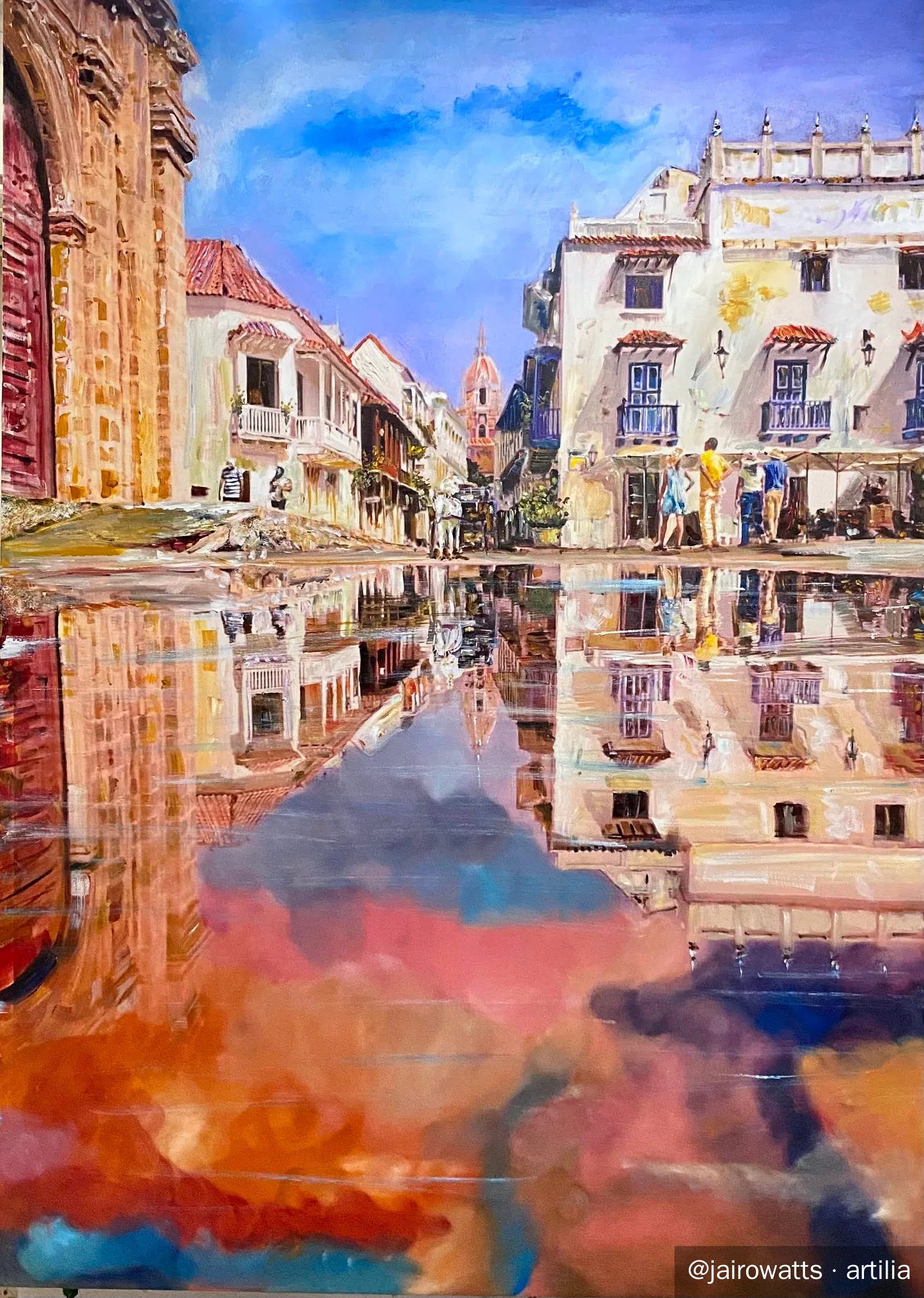
El Espejo de San Pedro Claver, original painting of Cartagena de Indias. Acrylic on canvas, 90 × 140 cm, by Colombian artist Jairo Watts. Available.
#PlazaDeLaAduana #Cartagena #CartagenaDeIndias #ColombianArt #CaribbeanArt #ColonialArchitecture #WalledCity #PedroDeHeredia #CaribbeanHeritage #OilPainting #ColombianPainter #HeroicCartagena #UNESCOHeritage #ColonialHistory #JuanDeCastellanos #ChroniclesOfTheIndies #HispanicCaribbean #ReflectionArt #ArtGallery #FineArt #CartagenaColonial #PoeticRealism #HistoricCenter #TravelArt #CaribbeanColombia
This painting builds its power in the mirror: Plaza de la Aduana doubles itself across a sheet of water that copies, inverted, every arch, every blue balcony, every human figure of the old walled city. The palette splits into two climates — above, the violet-blue of a Cartagena sky just catching its golden hour; below, the ochres, siennas and carmines of a reflection turned almost abstract, dissolved into loose, thickly loaded brushwork. The mirrored composition isn't chasing photographic precision but vibration itself: the cathedral tower rises in the distance as the axis holding both worlds together, the real and the reflected. There's a will in this technique — oil paint handled with loose, near-impressionist gesture — to capture not the stone but its temperature, not the place but its liquid memory.
And that memory runs deep. When Don Pedro de Heredia founded Cartagena in 1533, he chose the edge of what is now this square for his own house; there, alongside his brother Alonso, he withstood the assault of French pirate Roberto Baal in 1544, while the still-unwalled city lay open to any corsair bold enough to touch its shores. The plaza carried another name then, the "Antigua Real Contaduría," since royal officials dispatched from its building the gold, pearls, and goods flowing in and out of the Indies. Only in 1790 did the customs administration housed there give the square the name its stubborn, loyal citizens refused to abandon — even when the city council tried renaming it Plaza Colón, and later Plaza Rafael Núñez.
The chronicler Juan de Castellanos, priest and soldier, recorded this founding in his epic Elegías de Varones Ilustres de Indias, drawing on the accounts of those who watched the city rise over the former indigenous settlement of Calamarí. From these same stones sailed the news, the galleons, and the men who bound Cartagena to Santo Domingo, first American port of call for the Fleet of the Indies — a cord that for centuries tied the whole Hispanic Caribbean together, from Seville to the Dominican island, from the island to this square by the sea. Gabriel García Márquez, much later, chose it as backdrop for the loves and the cholera of his beloved city.
Today the canvas returns it to the sea that first witnessed it: as if all of Cartagena — its balconies, its people, its light — could not exist without seeing itself in the water, without remembering it was once plaza, port, and threshold of the Hispanic Caribbean. In that reflection trembles the entire inheritance of a walled city that learned, since the sixteenth century, to stand between stone and the memory of the sea.
Plaza de San Pedro Claver, Cartagena de Indias
A street in the historic center stretches between two rows of colonial facades, with the tower of the Church of San Pedro Claver rising in the distance, small and luminous against a violet-blue sky. On the left, a carved stone wall with a red wooden door fills much of the foreground, while on the right a white facade with blue balconies houses what looks like a café or a shop with awnings, where a group of people stand and talk. At the exact middle of the painting, a band of still water doubles the entire scene in a reflection that, curiously, is sharper and more detailed than the real street that produces it.
That inversion is the true center of gravity of the painting. The upper half, the street as any passerby would see it, is painted with loose, somewhat hurried brushstrokes, almost sketched, typical of a plein-air technique that favors the overall impression over detail. The lower half, by contrast, unfolds windows, balconies and stone textures with greater precision, as if the puddle did not simply reflect what is above but reinterpreted it with more care. The effect is unsettling: one tends to look longer at the reflection than at the original street, and that reverses the usual hierarchy between the real thing and its copy.
Below that band of water, the canvas dissolves into a wide area of warm ochre, pink and blue patches that no longer describe anything recognizable. This lower part works almost as a second painting within the same work, an abstract territory that could be read as the shadow cast by the puddle on the wet pavement, or simply as the point where the faithful depiction of the city gives way to the pure gesture of color.
San Pedro Claver, the church that gives the plaza its name, is where the Jesuit who devoted his life to caring for the enslaved people arriving in Cartagena, one of the busiest slave ports in colonial America, preached and is buried. The work does not point to that history explicitly, but it is worth keeping in mind when looking at this plaza, now a tourist and commercial setting, with visitors chatting in front of a café exactly where one of the deepest moral tensions of the colonial period once played out.
Between the sketched street, the meticulous reflection and the final patch of color that represents nothing at all, the painting builds three different ways of looking at the same place: the one you walk, the one that is reflected, and the one you simply feel, without needing to name it.
Details
- Technique
- Acrylic on canvas
- Size
- 90 × 140 cm
- Year
- 2025
- Collection
- Reflejos
- Place
- Cartagena de Indias
- Status
- Available
- Price
- USD $1,183
An original painting by Jairo Watts, Colombian artist of the Caribbean, signed and delivered with a certificate of authenticity registered on the blockchain. Contact the artist to buy it or to arrange shipping to your door.
International shipping with DHL Express to any country: canvas rolled in a tube, USD 150 on average, paid by the buyer and confirmed with you before dispatch. Stretched on its frame, shipping costs more and is quoted separately.