Rincon Plaza de los Coches - Cartagena
Original painting of Cartagena de Indias
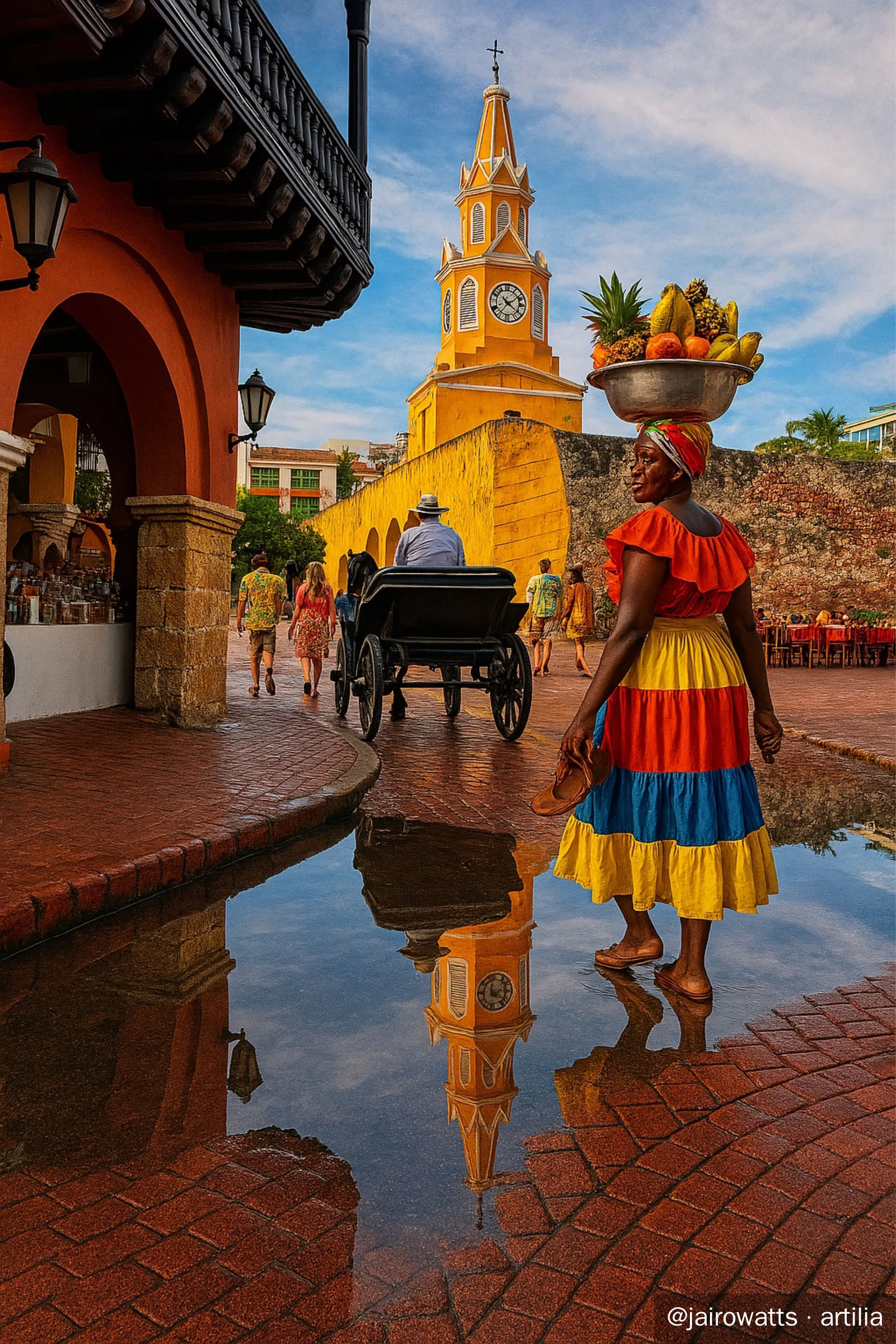
Rincon Plaza de los Coches - Cartagena, original painting of Cartagena de Indias. Acrylic on canvas, 140 × 90 cm, by Colombian artist Jairo Watts. Sold.
Mirror of Time, Plaza de los Coches, Jairo Watts, Colombian art, Torre del Reloj reflections, palenquera painting, Colombian art Miami, buy Colombian art New York, acrylic on canvas, San Basilio de Palenque heritage art
Rain arrives in Cartagena like an ancient storyteller. It descends slowly over the centuries-old stones, slides down the colonial balconies and awakens memories that seemed asleep within the walls of coral and lime. Then the miracle happens: Plaza de los Coches stops being merely a square and becomes a mirror in which the city contemplates its own soul.
The ephemeral waters cover the cobblestones and reflect the majestic Torre del Reloj, a silent guardian for more than a century and a half. Beneath its shadow have passed conquistadors, merchants, liberators, sailors, travelers and dreamers. It has seen galleons laden with gold depart and ships marked by Caribbean storms return. It has witnessed days of splendor and nights of resistance that forged the indomitable character of Cartagena de Indias.
Formerly known as Plaza del Arrabal, this space was for centuries the antechamber of the walled city. Through here entered goods from every corner of the world. Very close by operated the slave market of the colonial era, turning this place into the stage for some of the most complex and momentous pages of American history. Every stone seems to preserve the echo of those voices that time refused to erase.
Amid that setting appears the palenquera, a living symbol of Afro-Caribbean heritage. Her intense colors — red, yellow and blue — burst forth as a celebration of identity and freedom. Atop her head she carries not only fruit; she carries centuries of tradition, cultural resistance and ancestral pride. Her presence connects contemporary Cartagena with the deep roots of San Basilio de Palenque, the first free town in the Americas.
The reflections multiply the scene. The tower seems to rise from another century, while the colonial façades merge with the clouds and the rain. Present and past meet upon a liquid surface where reality becomes poetry. The city seems to pause for an instant to contemplate its own memory.
In this work I sought to capture that moment suspended in time: the instant when Cartagena stops being a physical place and becomes an emotion. A moment where history is reflected in the water, where the rain reveals the invisible and where every viewer can discover a different Cartagena — intimate and eternal.
Because Cartagena de Indias does not live only within its walls, its squares or its monuments. It lives in its memories, in its reflections, and in the stories that continue walking barefoot over the wet cobblestones.
Mirror of Time is an invitation to pause, look down, and discover that sometimes history is not written in books, but reflected in a puddle after the rain.
A woman dressed as a palenquera walks in profile, a bowl of tropical fruit balanced on her head, right at the threshold between an arcade of red arches and a cobbled street that opens toward the yellow Clock Tower. The wet ground doubles every element of the scene: the tower, the clouds, the woman's bare feet, in a mirror of water that turns the moment into two simultaneous images, the real one and its inverted reflection. In the background, a horse-drawn carriage moves toward the gate, while a handful of tourists wander among stone walls that still keep the ochre color of the colonial fortifications.
The composition works on a strongly marked axis of depth. The tower occupies the exact center of the painting, tall and narrow, while the woman stands in a lateral foreground, almost cut off by the right edge of the image. That deliberate imbalance, with her close and off to the side and the tower far away and centered, guides the viewer's eye in two moments: first the body, then the monument. Her tricolor dress, yellow, red and blue, works as a chromatic bridge between the two, repeating almost exactly the same ochre and golden tones of the stone and the clock, as if the figure had absorbed the color of the place she inhabits.
The architectural background is worth placing with some precision. The structure at the back is not a mere colonial backdrop. It was originally called the Boca del Puente, because at that point there was a wooden bridge over the old San Anastasio channel, the arm of the sea that separated the island of Calamarí, today's walled center, from the island of Getsemaní. The clock that crowns the tower and gives it its popular name arrived long after the gate itself: it was brought from the United States and installed in the nineteenth century, on a structure that had served for more than two centuries as the defensive entrance to the walled city. In other words, what is photographed today as a picturesque background was, for generations, the exact point where the fortified city decided who came in and who did not.
That tension between a historical threshold and an everyday one is perhaps the most interesting thing about the image. The woman does not cross the gate like someone crossing a military border, but like someone simply going to sell her fruit one more day. And yet the place where she stops remains, almost without the artist intending it, one of the points in the city where the colonial past and the present still touch most clearly, the present that walks, barefoot or in sandals, over its own reflection in the water.
Details
- Technique
- Acrylic on canvas
- Size
- 140 × 90 cm
- Year
- 2026
- Collection
- Reflejos
- Place
- Cartagena de Indias
- Status
- Sold
An original painting by Jairo Watts, Colombian artist of the Caribbean, signed and delivered with a certificate of authenticity registered on the blockchain. Contact the artist to buy it or to arrange shipping to your door.